I have a habit I don’t talk about much.
Whenever I’m somewhere, my own city, a country halfway across the world, doesn’t matter, I look up philosophy events. Discussion groups, roundtables, etc. Rooms full of strangers willing to sit down and argue about questions that have no answers.
Every single one has been worth it.
Here’s what happened at the most recent one.
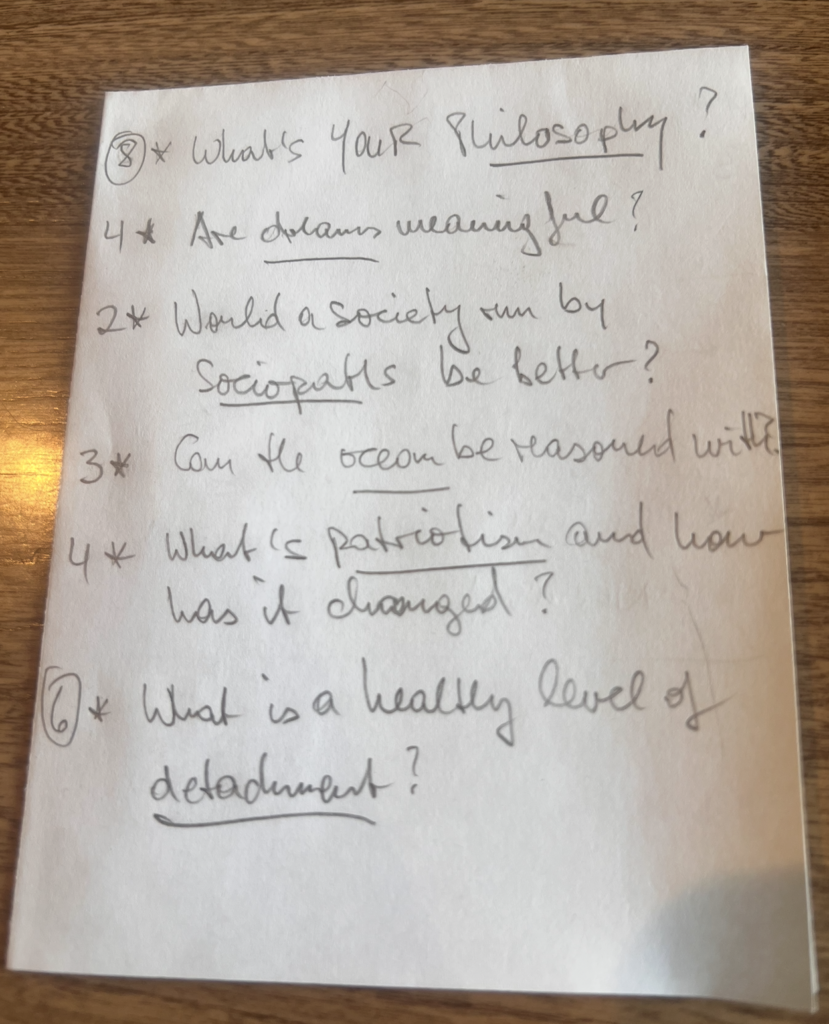
Photo: Not my handwriting
The Questions on the Table
The group votes on what to discuss. These were the contenders:
- What’s your philosophy?
- What is a healthy level of detachment?
- Are dreams meaningful?
- What’s patriotism and how has it changed?
- Can the ocean be reasoned with?
- Would a society run by sociopaths be better?
Some of the most interesting people can be found at philosophical discussions.
Desire Followed Me From Doha
At a philosophy event in Doha, Qatar. we spent an evening pulling apart the difference between a desire, a want, and a need. Months later, in a different room on a different continent, desire showed up again.
It reminded me of one of Ryan Holiday’s Daily Stoic readings — the idea that your desires make you a servant.
I don’t fully buy it.
Some desires align your actions and your habits with the exact outcome you’re chasing.
If a desire is pulling you toward the life you actually want, being its servant isn’t a weakness. It’s a strategy.
The question isn’t whether you serve your desires.
It’s whether you’d choose the master again if you saw where it was taking you.
The Physicist Who Couldn’t Find Meaning
When “what’s your philosophy?” hit the roundtable, the first person to answer had a PhD in physics. Rational to the bone. Logic as a first language.
His honest answer: he’s struggled his whole life to figure out the meaning of life.
Then someone asked the question underneath the question. What is the meaning of meaning? Why do we need life to mean something at all? The absurdists never lose sleep over this. They looked at an indifferent universe, shrugged, and kept living.
Here’s what I think.
Some people are cursed with existential curiosity. The question of meaning found them early and never left.
Other people will live an entire life and the question will simply never knock. They’re not shallow. They’re just not haunted.
The physicist is haunted. Most of that room was haunted. That’s probably why we were all there.
I’m a fan of Ecclesiastes since childhood. I agree that life could potentially and ultimately be meaningless* (from a limited knowledge perspective), but you should make the most of it, whilst living wisely. And I leave that asterisk there because…life is meaningless until you get the answers, which is why I believe you should live with wisdom.
The Luxury Nobody Mentions
Someone brought up Maslow’s hierarchy of needs, and it reframed the whole discussion.
The higher up the pyramid you live, the more likely you are to wrestle with meaning. When your basic needs are met, your mind goes looking for bigger problems.
When they’re not, there’s no room for “why am I here?” — you’re too busy answering “how do I get through this month?”
One woman put it in family terms. She’s a second-generation American. Two generations ago, her family wasn’t debating the meaning of life. They were surviving. Their stressors lived in the rent and the pantry, not in the mind.
At the end of the discussion, someone joked, “Well, did we solve philosophy?”
No. Obviously not.
But the closing line stuck with me: all of us had time to waste discussing philosophy. That sentence sounds like a throwaway. It’s actually the whole point. The ability to sit in a room and chase unanswerable questions is a privilege most of human history never had.
Is There More?
The conversation eventually drifted somewhere I didn’t expect from a room this rational.
People started sharing experiences — strange, abnormal moments that reason and reality couldn’t quite explain. Which cracked open the real question: is there more? Does spirituality have a place? A higher source, a higher something?
The physicist said no. He can’t find evidence.
But others — people just as rational as him — pushed back with their own experiences. Not arguments. Experiences. Things that happened to them that their own logic couldn’t file away.
Watching rational people wrestle with the limits of rationality is one of my favorite things on earth.
“Physics Is God’s Language”
The comment that stayed with me came from an older woman near the end.
She’s about to retire. When she does, she wants to study physics — because she believes physics is God’s language.
That landed on me hard, and here’s why. I study the Bible regularly, not religiously, but for wisdom. And if you spend enough time in it, you notice something: it’s mathematical. Patterns of numbers. Repetitions that don’t feel accidental. Clues left in plain sight that most people skim past.
I’ve been circling physics myself for a while now — quantum physics, metaphysics, books about the universe that reach past rationality. Maybe she’s right. Maybe the math underneath everything is a language, and some of us are just now learning to read it.
We didn’t solve philosophy that night.
Find a room of strangers and don’t solve it either.