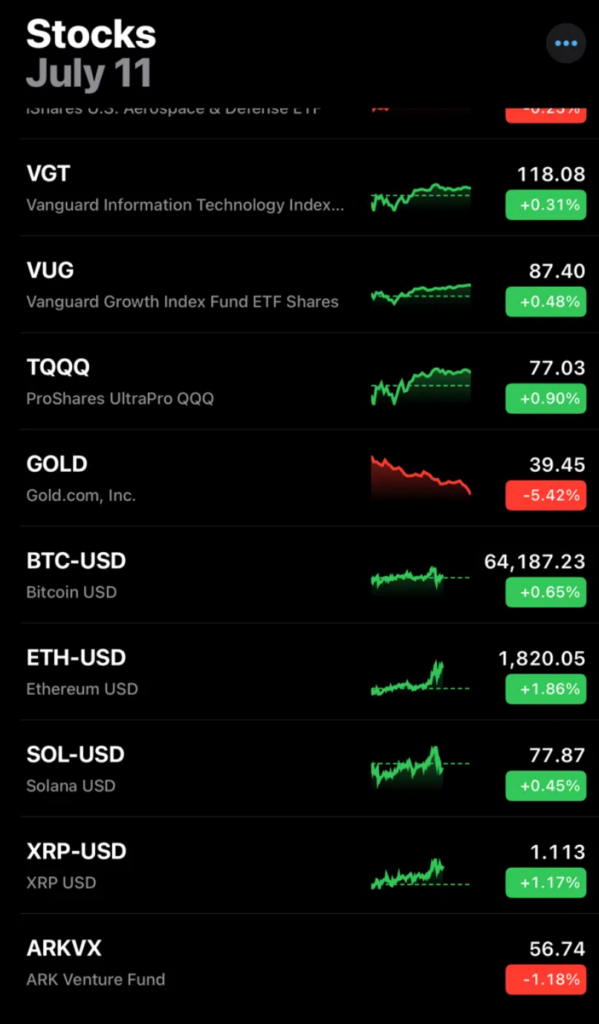
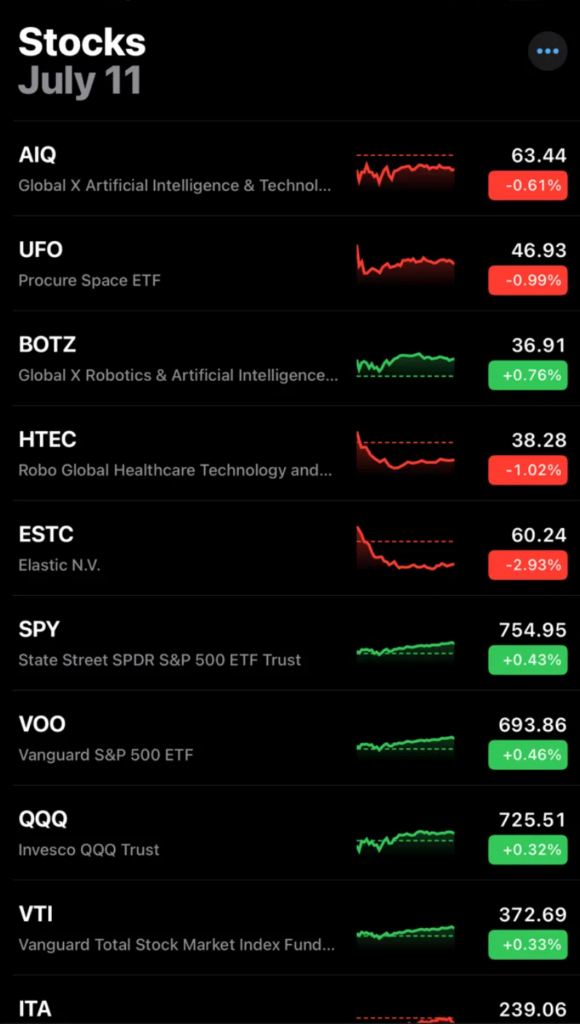
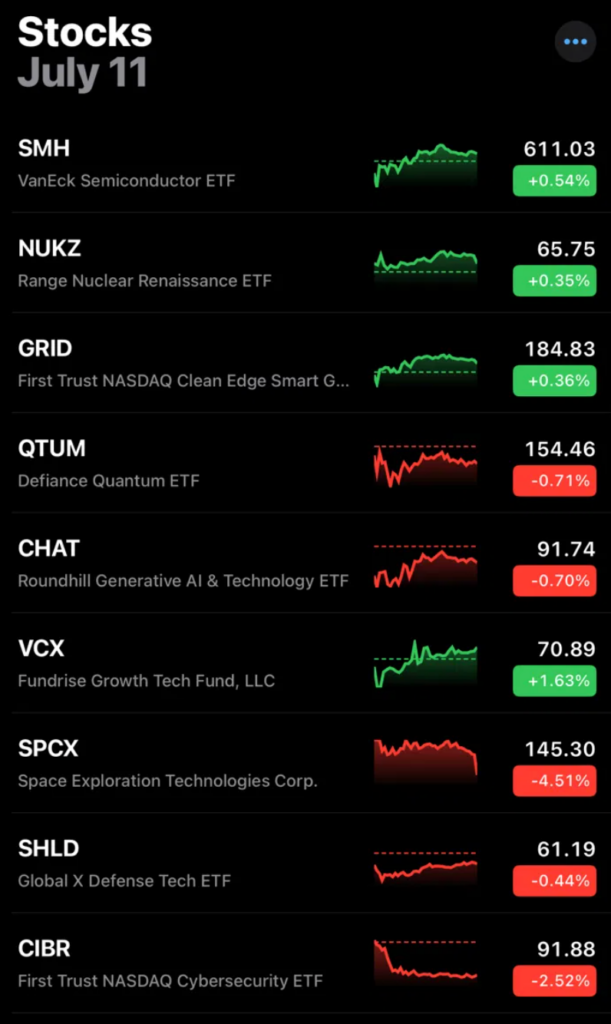
I check this watchlist every day. Not to trade, I rarely touch anything. I check it the way you glance at a city skyline: to see what’s being built.
One of the biggest lessons from two decades in the market is that you should know what you own and what you’re watching. Most people can’t tell you what’s inside the ETFs they hold. They bought a ticker, not a thesis.
So here’s some of the tickers on my daily list, what it actually is, what it holds, where it’s strong, and where it’s exposed. No recommendations. Just the map.
Quick note: Some of these I’m only watching now versus actively investing.
Broad Market Core
SPY: State Street SPDR S&P 500 ETF
The original S&P 500 tracker and the most liquid ETF on earth.
Top holdings mirror the index: Microsoft, Nvidia, Apple, Amazon, Alphabet.
Strength: unmatched liquidity and options market.
Weakness: 0.09% expense ratio, triple what VOO charges for the identical index.
VOO: Vanguard S&P 500 ETF
Same 500 companies, 0.03% fee.
Strength: the cheapest serious way to own the U.S. large-cap market.
Weakness: none unique to the fund, just the index’s own concentration, with the top 10 names now a third of the whole thing.
VTI: Vanguard Total Stock Market ETF
The entire U.S. market: roughly 3,600 stocks, large through micro cap, at 0.03%.
Strength: total ownership of American equity in one ticker.
Weakness: it’s cap-weighted, so in practice it behaves almost identically to the S&P 500; the small-cap exposure is real but diluted.
QQQ: Invesco QQQ Trust (Nasdaq-100)
The 100 largest non-financial Nasdaq companies, effectively the mega-cap tech index. SpaceX joined the index in July 2026, which pulled billions in passive flows into the stock.
Strength: the growth engine of the last two decades.
Weakness: extreme top-heaviness, 0.20% fee (QQQM tracks the same index cheaper), and it falls hardest when rates or sentiment turn.
VUG: Vanguard Growth ETF
The growth half of the U.S. large-cap market at 0.04%.
Strength: dirt-cheap growth tilt.
Weakness: massive overlap with QQQ and VGT, holding all three is mostly buying Microsoft, Apple, and Nvidia three times.
VGT: Vanguard Information Technology ETF
Pure tech sector fund. Apple, Microsoft, and Nvidia alone make up close to half the fund.
Strength: cheapest way (0.09%) to overweight technology specifically.
Weakness: sector classification quirks exclude Alphabet, Amazon, and Meta, so it’s less “big tech” than it looks, and the top-three concentration is severe.
TQQQ: ProShares UltraPro QQQ
3x daily leveraged Nasdaq-100.
Strength: explosive compounding in sustained uptrends.
Weakness: everything else, volatility decay from the daily reset, path dependency, and drawdowns that have exceeded 80% in real bear markets. A holding for people who genuinely won’t panic-sell.
Thematic Tech
SMH: VanEck Semiconductor ETF
~25 chip names: Nvidia, TSMC, Broadcom, AMD, ASML.
Strength: the purest large-cap play on the silicon layer everything else in AI sits on.
Weakness: brutal concentration, the top three names dominate the fund, and semiconductors remain a boom-bust cycle industry no matter what the current narrative says.
AIQ: Global X Artificial Intelligence & Technology ETF
Broad AI basket, ~85 holdings, mixing U.S. mega-caps with international names.
Strength: diversification across the AI theme rather than a bet on five stocks.
Weakness: that same breadth dilutes the theme, and much of it overlaps what you already own in QQQ or VGT.
CHAT: Roundhill Generative AI & Technology ETF
Actively managed, tightly focused generative-AI fund: Nvidia, Microsoft, Alphabet, plus AI software and infrastructure.
Strength: an active manager curating the theme instead of an index formula.
Weakness: 0.75% fee for a portfolio whose biggest positions you likely already hold elsewhere.
BOTZ: Global X Robotics & Artificial Intelligence ETF
Industrial automation and robotics: Nvidia, Intuitive Surgical, ABB, Fanuc, Keyence.
Strength: real exposure to physical automation, factories and surgical robots, not just chatbots.
Weakness: heavy weighting to Japanese industrials makes it cyclical and currency-sensitive.
QTUM: Defiance Quantum ETF
Quantum computing plus adjacent machine learning and semiconductor names: IonQ, Rigetti, and D-Wave alongside established chipmakers.
Strength: the broadest quantum basket available, with the semis providing ballast.
Weakness: the pure quantum names are largely pre-profit and violently volatile, while the ballast dilutes the actual thesis.
CIBR: First Trust NASDAQ Cybersecurity ETF
CrowdStrike, Palo Alto Networks, Broadcom, Cisco, Zscaler.
Strength: cybersecurity spending is one of the least discretionary line items in any corporate budget.
Weakness: rich valuations across the pure-plays, and the Cisco/Broadcom weightings water down the theme.
ESTC: Elastic N.V. The company behind Elasticsearch — search, observability, and security software, now pushing hard into vector search for AI retrieval.
Strength: a massive installed developer base and genuine relevance to how AI applications find data.
Weakness: crowded field — hyperscaler alternatives, open-source forks, and dedicated vector databases all want the same workloads, and growth has been uneven.
Infrastructure & Energy
NUKZ: Range Nuclear Renaissance ETF
The nuclear buildout: reactor and component makers, fuel-cycle companies, SMR developers, and nuclear-heavy utilities.
Strength: the most direct basket exposure to data-center-driven electricity demand meeting nuclear supply.
Weakness: young, small fund; the SMR names inside it are mostly pre-revenue, and nuclear timelines run in decades, not quarters.
GRID: First Trust NASDAQ Clean Edge Smart Grid Infrastructure
The wires, switches, and transformers of electrification: Eaton, Quanta Services, Schneider Electric, ABB.
Strength: picks-and-shovels industrials with real earnings, every energy trend, from AI data centers to EVs, runs through the grid.
Weakness: ~0.56% fee, and these are capex-cycle businesses sensitive to rates.
Defense & Space
ITA: iShares U.S. Aerospace & Defense ETF
The primes: GE Aerospace, RTX, Boeing, Lockheed Martin, Northrop.
Strength: entrenched government customers and a multi-year global rearmament cycle.
Weakness: Boeing exposure, program cost-overrun risk, and meaningful overlap with SHLD.
SHLD: Global X Defense Tech ETF
Defense with a tech tilt: Palantir, Rheinmetall, plus traditional primes and European names.
Strength: captures the software-and-drones side of modern defense that ITA underweights, plus international budgets.
Weakness: Palantir-heavy, meaning a big chunk of the fund trades on one stock’s valuation multiple.
UFO: Procure Space ETF
The only broad pure-play space basket: satellite operators, launch, and ground infrastructure — > Rocket Lab, Iridium, and peers.
Strength: diversified exposure to an industry that finally has a real public market.
Weakness: many holdings are low-margin legacy satellite operators, and the fund is small and volatile.
SPCX: Space Exploration Technologies Corp. (SpaceX)
Newly public as of June 2026. Three segments: launch (Falcon, Starship), connectivity (Starlink’s satellite constellation serving customers in 160+ countries), and AI; the company absorbed xAI in early 2026, so Grok and X now live inside it.
Strength: near-monopoly position in launch plus Starlink’s recurring revenue.
Weakness: a valuation priced for multiple miracles, key-man risk in one founder, a thin float, and a stock that has already corrected hard from its post-IPO high.
Alternatives & Venture
VCX: Fundrise Innovation Fund
A publicly traded venture fund holding private tech: recent top holdings include Anthropic, Databricks, OpenAI, Anduril, Ramp, and pre-IPO SpaceX.
Strength: genuine retail access to the private AI names everyone else can only read about.
Weakness: a 1.85% management fee, illiquid holdings valued by appraisal rather than market, and heavy concentration in a handful of positions.
ARKVX: ARK Venture Fund
Cathie Wood’s private-market vehicle: venture stakes in companies like Anthropic and Epic Games alongside public disruptors.
Strength: same private-access appeal as VCX with ARK’s network behind it.
Weakness: a steep expense ratio, quarterly-only liquidity windows, and ARK’s boom-bust track record attached to the name.
GOLD: Gold.com, Inc.
Not Barrick, and not bullion. This is the former A-Mark Precious Metals, rebranded Gold.com in December 2025; a vertically integrated precious metals dealer running wholesale trading, direct-to-consumer brands like JM Bullion, and secured lending.
Strength: it profits from transaction volume and spreads whenever retail interest in metals spikes.
Weakness: razor-thin margins on enormous revenue, and earnings that swing hard with metal price volatility. Owning the dealer is not the same as owning the metal.
Crypto
BTC: Bitcoin
The original scarcity asset — fixed 21 million supply, deepest liquidity, institutional ETF adoption.
Strength: the closest thing crypto has to a reserve asset.
Weakness: no cash flows, no yield, and drawdowns of 50%+ remain part of the deal.
ETH: Ethereum
The dominant smart-contract platform; most stablecoins, DeFi, and tokenization run on it, and staking produces native yield.
Strength: the largest developer ecosystem in crypto by a wide margin.
Weakness: faster, cheaper competitors keep taking share of new activity, and its value-capture story is more complicated than Bitcoin’s.
SOL: Solana
High-throughput, low-fee blockchain that became the home of consumer crypto activity.
Strength: speed and cost make it the retail-favorite chain for trading and apps.
Weakness: a history of network outages and ongoing centralization critiques.
XRP: XRP (Ripple)
Built for cross-border payments and settlement.
Strength: an actual institutional use case and regulatory clarity most tokens lack.
Weakness: the investment case leans heavily on bank adoption that has been perpetually “coming” for a decade.